
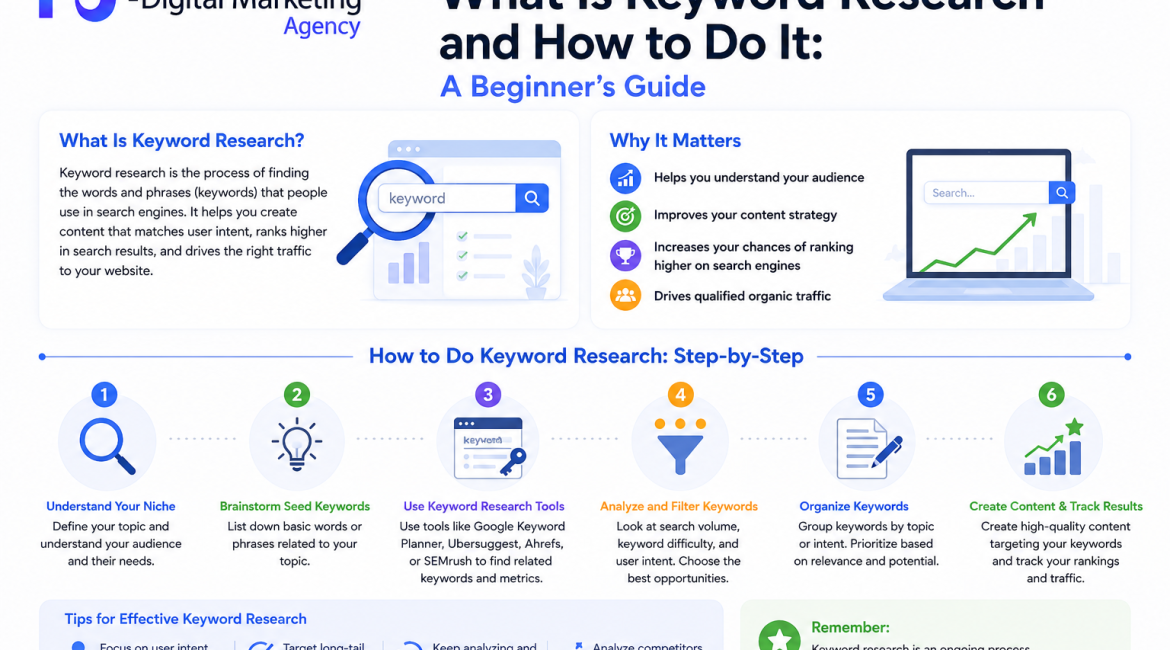
You’ve heard that keywords are important for SEO. Someone told you to “do keyword research” before writing content. But nobody explained what that actually means or how to do it.
You’re not alone. Most business owners find keyword research confusing. They guess at words. They write content. They wonder why nobody finds them.
Let me fix that. Here’s exactly what is keyword research and how to do it in plain English.
The Short Answer
Keyword research is the process of finding out what words and phrases people actually type into Google when looking for what you sell. Then you create content around those words.
It’s like mind reading. You’re figuring out what your customers are already searching for so you can give it to them.
Understanding what is keyword research and how to do it starts with understanding why guessing fails.
Why You Can’t Just Guess Keywords
Most business owners think they know what their customers search for. They’re usually wrong.
You might call yourself a “residential plumbing contractor.” Your customers search for “plumber near me” or “fix leaky faucet.” You might say you offer “commercial cleaning services.” Customers search for “office cleaner [city name]” or “janitorial services near me.”
The words you use to describe your business are often different from the words customers use to find businesses like yours. That gap is why keyword research matters.
Keyword research closes that gap. It tells you the actual words real people type into Google. Then you use those exact words on your website. Google sees the match. Google shows your site. Customers find you.
That’s the foundation of what is keyword research and how to do it. It’s translation work between business language and customer language.
Step 1: Brainstorm Seed Keywords
Start with the obvious. Write down every word or phrase that describes your business. Don’t overthink it. Just brain dump.
For a pizza restaurant, seed keywords might be: pizza, pizza restaurant, pizza delivery, pizza near me, best pizza, thin crust pizza, New York pizza, pizza slices, family pizza place.
For a plumber, seed keywords might be: plumber, plumbing repair, leaky faucet, clogged drain, water heater repair, emergency plumber, bathroom plumbing, pipe repair.
These seed keywords are your starting point. They’re not the final list. They’re just the seeds that will grow into a full keyword strategy. Even this basic step helps clarify what is keyword research and how to do it for your specific business.
Step 2: Use Free Keyword Research Tools
Now you need data. You need to know how many people search for each keyword and how hard it will be to rank.
Here are free tools to get started:
Google Autocomplete: Start typing a seed keyword into Google. Don’t press enter. Look at the suggestions that pop up. Those are real searches people make. For example, type “plumber” and Google suggests “plumber near me,” “plumber cost,” “plumber emergency,” “plumber hourly rate.” Each suggestion is a keyword opportunity.
Google Related Searches: Type a seed keyword into Google and scroll to the bottom of the results page. Look for “Searches related to [your keyword].” These are also real searches. Add them to your list.
AnswerThePublic: This free tool shows you questions people ask about any topic. Type “plumber” and it shows “how to find a plumber,” “when to call a plumber,” “why are plumbers so expensive.” These question-based keywords are gold for blog content.
Google Keyword Planner: You need a Google Ads account (free to create). Go to Tools > Keyword Planner > Discover new keywords. Enter your seed keywords. Google shows you search volume and competition level. This is the most reliable free data available.
Using these tools is the practical answer to what is keyword research and how to do it without spending money.
Step 3: Analyze Search Volume and Difficulty
Not all keywords are created equal. Some are worth targeting. Some are a waste of time.
Search volume: How many people search for this keyword each month? High volume (1,000+ searches per month) means lots of potential traffic but also lots of competition. Low volume (10 to 50 searches per month) means less traffic but easier to rank. For most small businesses, keywords with 100 to 500 searches per month are the sweet spot.
Keyword difficulty: How hard is it to rank for this keyword? Low difficulty means few competitors have optimized for it. High difficulty means big brands dominate the first page. As a small business, focus on low to medium difficulty keywords first. Build authority. Then go after harder keywords later.
Intent: Why is someone searching this keyword? Are they looking to buy (transactional), looking for information (informational), or trying to find a specific website (navigational)? For service businesses, keywords with local intent (“plumber near me”) or problem-solving intent (“how to fix leaky faucet”) convert best.
Analyzing these three factors turns a list of words into a strategic plan. That’s the real what is keyword research and how to do it skill.
Step 4: Understand Keyword Types
Let me break down the three main types of keywords you’ll target.
Head terms (short, generic, high volume): “Plumber.” “Pizza.” “SEO.” These are very hard to rank for. They attract broad traffic that may not convert. Don’t focus here as a small business.
Body terms (medium length, moderate volume): “Emergency plumber near me.” “Thin crust pizza delivery.” “Local SEO company.” These are achievable for most small businesses. They attract targeted traffic that often converts.
Long-tail keywords (long, specific, low volume): “How to fix a running toilet flapper.” “Best gluten free pizza in downtown.” “Cost to hire SEO agency for small business.” These are easiest to rank for. They attract highly motivated searchers who often buy. Long-tail keywords make up the majority of searches online.
Most of your keyword research should focus on long-tail and body terms. That’s the practical application of what is keyword research and how to do it for small business owners.
Step 5: Map Keywords to Your Website Pages
Now you have a list of keywords. Don’t stuff them all onto one page. Map each keyword to the right page.
Homepage: Your brand name and primary service category. “Plumber in [city].” “Best pizza restaurant.” Keep it focused.
Service pages: Specific services you offer. “Water heater repair.” “Clogged drain cleaning.” “Emergency plumbing.” Each service gets its own page with its own keywords.
Location pages: If you serve multiple cities. “Plumber in Northside.” “Plumber in Southside.” “Plumber in Eastside.” Each location gets its own page.
Blog posts: Question-based and informational keywords. “How to fix a leaky faucet.” “When to replace water heater.” “Signs you need a plumber.” Blog posts target long-tail keywords that don’t fit on service pages.
About page: Brand keywords and team keywords. Your company name. Owner name. These are usually low competition and easy to rank for.
Proper mapping ensures each page has a clear focus. That’s the final step in understanding what is keyword research and how to do it for a website.
Common Keyword Research Mistakes to Avoid
Let me save you from these errors.
Mistake #1: Targeting only high-volume keywords. You’ll never outrank Home Depot or Yelp for “plumber.” Target local, specific, long-tail keywords instead. Win the battles you can win.
Mistake #2: Ignoring local modifiers. Add your city, neighborhood, or region to keywords. “Plumber” is impossible. “Plumber in [your city]” is achievable. Local SEO is your friend.
Mistake #3: Keyword stuffing. Using the same keyword over and over until the page reads unnaturally. Google penalizes this. Write for humans first. Use keywords naturally.
Mistake #4: Never updating keyword research. Trends change. Customer language changes. Review your keyword research every 6 to 12 months. Update your content accordingly.
Avoid these and you’re ahead of most business owners trying to learn what is keyword research and how to do it on their own.
The Bottom Line
Keyword research isn’t complicated. Brainstorm seed keywords. Use free tools to find what customers actually search. Analyze volume, difficulty, and intent. Focus on long-tail and local keywords. Map each keyword to the right page on your website.
That’s what is keyword research and how to do it in practice. It’s not a one-time project. It’s an ongoing process. Customer language changes. Your business changes. Keep researching. Keep optimizing.
Do this right and you’ll stop guessing what to write. You’ll know exactly what your customers are searching for. You’ll give it to them. Google will reward you with rankings, traffic, and leads.
