
You’re learning about SEO. You keep hearing two phrases — on page SEO and off page SEO. Some people say one is more important than the other. Others say you need both.
It’s confusing. And most explanations are full of jargon that doesn’t help.
Let me break down the on page SEO vs off page SEO difference in simple terms. No fluff. Just what you need to know.
The Short Answer
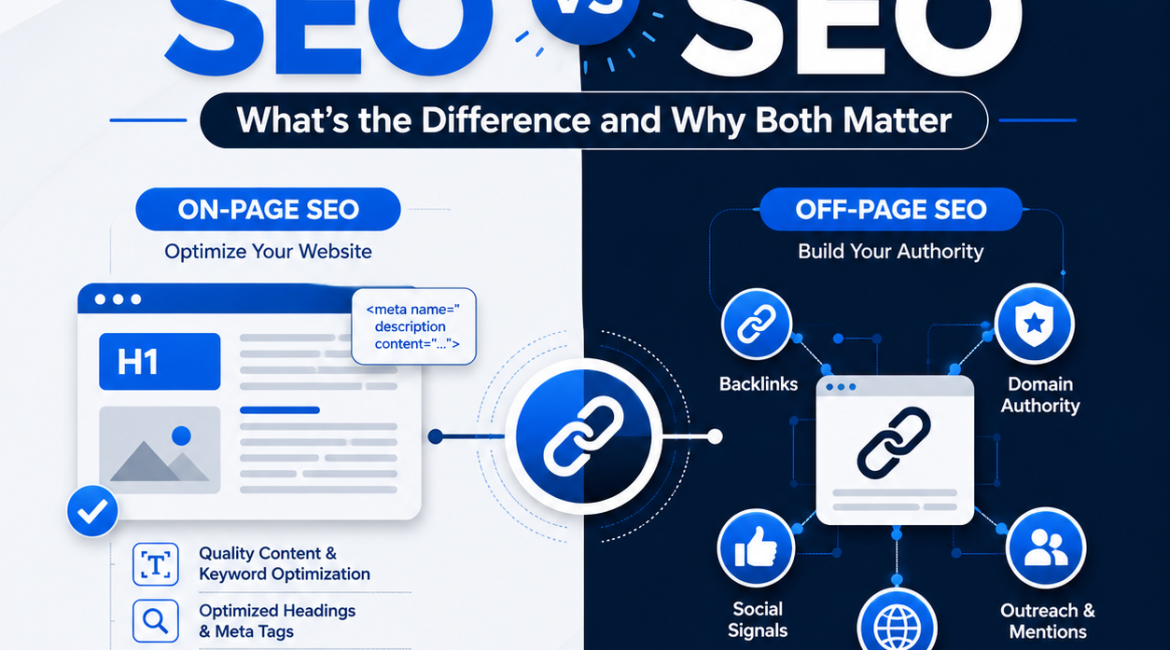
On page SEO is everything you do on your own website to help Google understand it. Off page SEO is everything you do away from your website to build trust and authority.
Think of on page SEO as what you say about yourself. Off page SEO is what others say about you. Both matter. Google wants to see that you say the right things and that other reputable sites agree.
Understanding on page SEO vs off page SEO starts with knowing what each one includes.
What Is On Page SEO?
On page SEO is anything you can control directly on your website. Every text, image, and code element is fair game. You don’t need anyone’s permission. You just need to do the work.
Key on page SEO elements:
Content: The words on your pages. Blog posts. Service descriptions. Product pages. About page. Every word matters. Your content should answer customer questions, use relevant keywords naturally, and be comprehensive enough to satisfy search intent.
Title tags: The blue clickable headline in search results. This is one of the most important on page factors. Each page needs a unique, descriptive title that includes your target keyword. Keep it under 60 characters so it displays fully.
Meta descriptions: The short description under the title in search results. This doesn’t directly help rankings but it strongly affects click-through rates. Write compelling meta descriptions that make people want to click. Keep them under 160 characters.
Headings (H1, H2, H3): The structure of your content. Your page should have one H1 (main title). Use H2s for major sections. Use H3s for subsections. Headings help Google understand your content hierarchy.
URL structure: The web address of each page. Short, descriptive URLs with keywords perform best. “website.com/plumber” is better than “website.com/page?id=123.”
Internal links: Links from one page on your site to another. These help Google discover all your pages and understand which pages are most important. They also keep visitors on your site longer.
Image optimization: File names, alt text, and file sizes. Use descriptive file names (plumber-repair-pipe.jpg not IMG_1234.jpg). Add alt text that describes the image. Compress images so they load fast.
Page speed: How fast your pages load. Slow pages frustrate users and rank poorly. Compress images, use caching, and choose fast hosting.
Mobile friendliness: Does your site work well on phones? Most searches happen on mobile now. Google prioritizes mobile-friendly sites. Test your site with Google’s mobile-friendly tool.
That’s the first half of the on page SEO vs off page SEO comparison. Everything on your site that you can control.
What Is Off Page SEO?
Off page SEO is everything that happens away from your website. You can influence it, but you can’t directly control it. It’s about building your website’s reputation across the internet.
Key off page SEO elements:
Backlinks: Links from other websites to your website. This is the most important off page factor. Google treats each backlink as a vote of confidence. More votes from reputable sites = higher trust = better rankings. Quality matters more than quantity. One link from a local news site is worth more than 100 links from random directories.
Google Business Profile signals: Your Google Business Profile is technically off page because it lives on Google’s platform. Complete profiles with photos, posts, and attributes rank better. Positive reviews strongly influence local rankings.
Local citations: Mentions of your business name, address, and phone number on other websites. Yelp. Yellow Pages. Better Business Bureau. Chamber of Commerce. Consistent citations across quality sites build local authority.
Social signals: Shares, likes, and mentions on social media. Google has said social signals are not direct ranking factors. But social visibility often leads to backlinks and brand searches, which do help rankings.
Brand mentions: When other websites mention your business name even without a link. Google can track these unlinked mentions. They contribute to your brand authority.
Reviews and ratings: Customer reviews on Google, Yelp, Facebook, and industry sites. Positive reviews build trust with both Google and potential customers. Responding to reviews shows engagement.
That’s the second half of the on page SEO vs off page SEO comparison. Everything off your site that builds your reputation.
Which One Is More Important?
This is the question everyone asks. Here’s the honest answer. You need both. But they matter at different times.
On page SEO is the foundation. If your on page SEO is bad, off page SEO won’t save you. Google won’t send links to a slow, confusing, unhelpful website. No amount of backlinks can fix terrible content.
Off page SEO is the accelerator. Once your on page SEO is solid, off page SEO determines how high you rank. In competitive industries, the site with more quality backlinks almost always wins.
Think of it this way. On page SEO gets you in the game. Off page SEO helps you win the game.
When comparing on page SEO vs off page SEO for a brand new website, start with on page. Fix technical issues. Create quality content. Optimize your pages. Once that’s solid, build off page signals. Get backlinks. Earn reviews. Build citations.
How They Work Together
Here’s what most guides miss. On page and off page SEO reinforce each other.
Great on page content attracts natural backlinks. When you write something genuinely helpful, other websites link to it. That’s off page SEO happening automatically because of good on page work.
Strong off page signals make your on page work more effective. When Google trusts your site because of quality backlinks, your new content ranks faster. You don’t have to wait months for each new page to climb.
Reviews on your Google Business Profile (off page) make people more likely to click your listing in search results. Higher click-through rates (on page behavior) tell Google your listing is relevant.
Internal links (on page) help Google discover your content. That content earns backlinks (off page). Those backlinks boost your whole site’s authority. That authority helps all your pages rank better.
That synergy is why the on page SEO vs off page SEO debate is misleading. It’s not versus. It’s together.
Where to Focus First as a Small Business
Let me give you a practical order of operations.
Phase 1 (Months 1 to 3): Focus entirely on on page SEO. Fix technical issues. Optimize your core pages (homepage, service pages, about page, contact). Claim and complete your Google Business Profile. Make sure your site works on mobile and loads fast. Create 5 to 10 foundational blog posts answering common customer questions.
Phase 2 (Months 3 to 6): Start building off page signals while maintaining on page. Get listed in local directories (Chamber of Commerce, Better Business Bureau, industry sites). Ask happy customers for Google reviews. Start reaching out for backlinks from local partners, suppliers, and community organizations.
Phase 3 (Months 6 to 12): Ramp up both. Publish content consistently (weekly or bi-weekly). Build backlinks consistently. Monitor your rankings. Double down on what’s working. Cut what isn’t.
This balanced approach respects the on page SEO vs off page SEO relationship. You need both. But you need on page first.
The Bottom Line
On page SEO is what you say about yourself on your website. Off page SEO is what others say about you across the internet. Google needs both to trust you.
The on page SEO vs off page SEO question isn’t about choosing one. It’s about understanding that on page is the foundation and off page is the accelerator. Start with on page. Add off page. Maintain both over time.
Do that consistently and your website will climb the rankings. Not overnight. But steadily. And when you get there, you’ll stay there because you built both the foundation and the reputation.
