
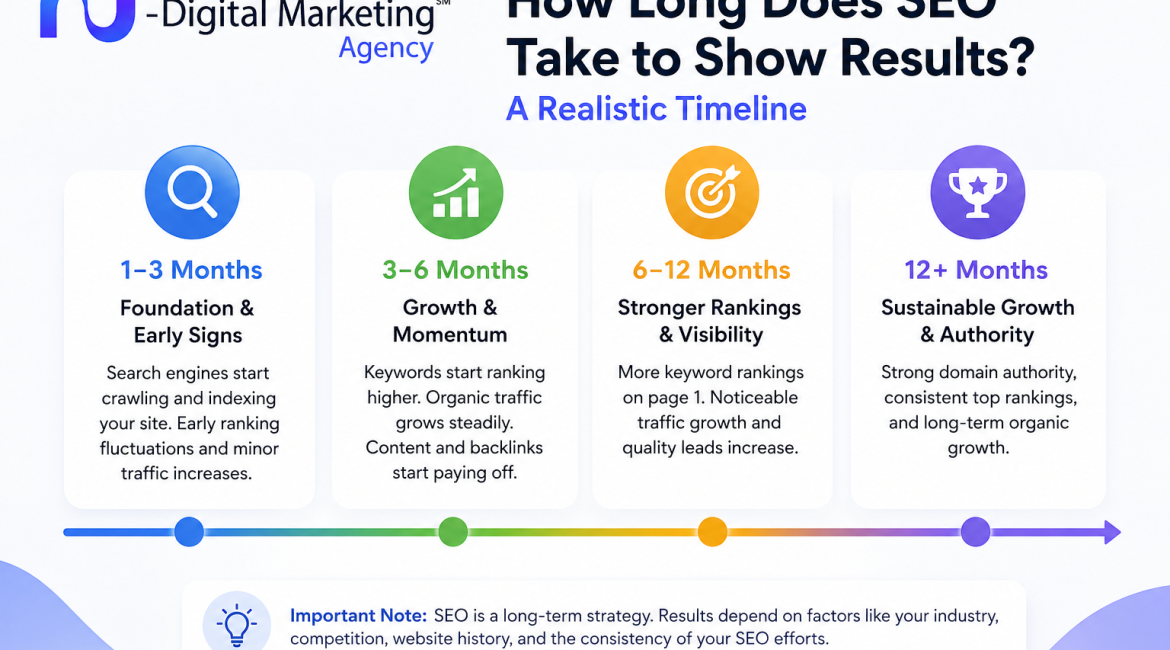
You hired an SEO agency. Or you started doing SEO yourself. You’ve been working hard for weeks. Maybe even months. And you’re checking Google every morning, hoping to see your website climb.
Nothing yet. Or very little. And you’re starting to wonder — is any of this working?
Let me give you an honest answer to how long does SEO take to show results. No hype. No false promises. Just real timelines based on hundreds of campaigns.
The Short Answer
Most businesses see meaningful SEO results in 4 to 12 months. Some see movement in 3 months. Others take 18 months. It depends on your industry, competition, and starting point.
Anyone who guarantees SEO results in 30 days is lying to you. Flat out lying. SEO doesn’t work that way.
Understanding how long does SEO take to show results starts with understanding what Google has to do before you rank.
What Has to Happen Before You Rank?
Let me walk you through what happens behind the scenes. This will help you understand why SEO takes time.
Step 1: Google has to find your website. Google sends out robots called crawlers. They browse the web, following links from page to page. If your site is new or has no links pointing to it, Google might not even know you exist yet. This alone can take weeks.
Step 2: Google has to index your pages. Finding your site isn’t enough. Google has to read every page, understand what it’s about, and store it in their massive database. This is called indexing. Indexing can take days to weeks for new content.
Step 3: Google has to evaluate your relevance. For each search query, Google looks at every indexed page and decides how relevant it is. Does your page answer the question? Is it comprehensive? Does it match search intent? This evaluation happens constantly but rankings don’t update instantly.
Step 4: Google has to evaluate your authority. Relevance alone isn’t enough. Google also wants to show trustworthy, authoritative websites. Authority comes from backlinks, reviews, age of domain, and many other factors. Building authority takes months or years.
Step 5: Google has to decide you’re better than competitors. Even if you’re relevant and authoritative, you’re competing against every other business in your space. Outranking established competitors takes time and consistent effort.
Those five steps explain how long does SEO take to show results. It’s not instant because Google has to do all this work before showing your site.
The Realistic Timeline by Phase
Let me break down what you can expect month by month.
Months 1 to 3: The Foundation Phase
What’s happening: Technical SEO fixes. Website speed improvements. Mobile optimization. Fixing broken links. Submitting sitemaps. Setting up Google Search Console. Claiming Google Business Profile. Basic on-page optimization for key pages.
What you’ll see: Very little movement in rankings. Maybe a few long-tail keywords (very specific, low competition searches) will start showing up on page 2 or 3. Organic traffic might increase slightly, but not much. Don’t expect leads from SEO yet.
This phase feels frustrating. You’re working hard with nothing to show. But the foundation is critical. Skip it and nothing else works.
Months 4 to 6: The Early Movement Phase
What’s happening: Content creation ramps up. Blog posts targeting specific questions. Service pages optimized. Local citations built. Reviews gathered. First backlinks acquired.
What you’ll see: Some keywords will move from page 5 to page 2 or 3. A few keywords might hit page 1 for low-competition searches. Organic traffic increases noticeably. You might get your first lead or two from SEO. You’ll start feeling encouraged.
This is where many business owners quit because they expected faster results. Don’t quit. You’re just getting started.
Months 7 to 12: The Acceleration Phase
What’s happening: Consistent content publishing. Link building continues. Old content gets updated. Reviews keep coming. Google starts trusting your site more.
What you’ll see: Competitive keywords start climbing. Many keywords hit page 1. Organic traffic grows steadily month over month. Leads from SEO become consistent. You’ll know exactly what content works and what doesn’t.
This is when SEO starts feeling worth it. The investment pays off.
Months 12 to 24: The Compounding Phase
What’s happening: You have a content library. You have backlinks. You have authority. Google sees you as an established site. You’re optimizing what works and cutting what doesn’t.
What you’ll see: Rankings stabilize at the top. Organic traffic grows even without new content because existing pages keep climbing. SEO becomes a reliable lead channel. You’ll reduce ad spend because organic is delivering.
This is the goal. This is why understanding how long does SEO take to show results matters. You have to survive the first year to get here.
That’s the honest timeline for how long does SEO take to show results. Not 30 days. Not 3 months for most businesses. Real results take a year.
Factors That Speed Up or Slow Down SEO
Let me give you the variables that affect your timeline.
Factors that speed up SEO: Existing website authority (older domains rank faster). Low competition keywords (local SEO moves faster than national). Quality backlinks from reputable sites. Consistent publishing schedule (weekly blog posts). Complete Google Business Profile with many reviews. Technical SEO done right the first time.
Factors that slow down SEO: Brand new website (Google doesn’t trust new sites). High competition keywords (everyone is fighting for them). Few or low-quality backlinks. Inconsistent content publishing. Incomplete or unverified Google Business Profile. Technical SEO issues (slow site, broken pages, mobile problems). Previous penalties from Google (hard to recover).
Be honest about where you stand. A new website in a competitive city will take longer than an established site in a small town.
Why You Should Be Skeptical of Fast SEO Promises
If someone promises you #1 rankings in 30 days, run away. Here’s why.
Fast SEO usually means black hat SEO. Buying backlinks. Keyword stuffing. Cloaking. Doorway pages. These tactics might work temporarily. But when Google catches on — and it always does — your site will be penalized. You’ll disappear from search results completely. Recovering from a penalty takes months or years.
Real SEO is slow because Google is slow on purpose. Google wants to prevent manipulation. It takes time to verify that your site is genuinely helpful, not just optimized.
So when someone asks how long does SEO take to show results, the honest answer is “as long as it takes for Google to trust you.” That’s usually 6 to 12 months for meaningful results.
What You Should Measure While You Wait
Don’t just stare at rankings. Measure progress along the way.
Month 1 to 3: Track technical fixes completed. Number of pages indexed. Google Search Console errors fixed. Local citations built. These are leading indicators. They predict future rankings.
Month 4 to 6: Track keyword movement (even from page 10 to page 8). Organic traffic growth (even small). Click-through rates from impressions. Time on site. These are mid-funnel metrics.
Month 7 to 12: Track leads from organic search. Revenue from organic search. Cost per lead compared to ads. Return on SEO investment. These are the metrics that actually matter.
Tracking the right metrics keeps you motivated while you wait for the big results.
The Bottom Line
So how long does SEO take to show results? For most small businesses, 4 to 6 months to see early movement. 7 to 12 months to see meaningful traffic and leads. 12 to 24 months to see SEO become a primary channel.
That sounds like a long time. But here’s the flip side. Once you have it, SEO keeps delivering. Every month. Every year. Without paying per click. Without resetting budgets. A single blog post can bring leads for years.
Paid search is a rental. Organic search is ownership. That’s why the wait is worth it.
Start SEO now. Measure progress along the way. Don’t quit in month 3. The businesses that outlast the timeline are the ones that dominate search results. Be one of them.
