
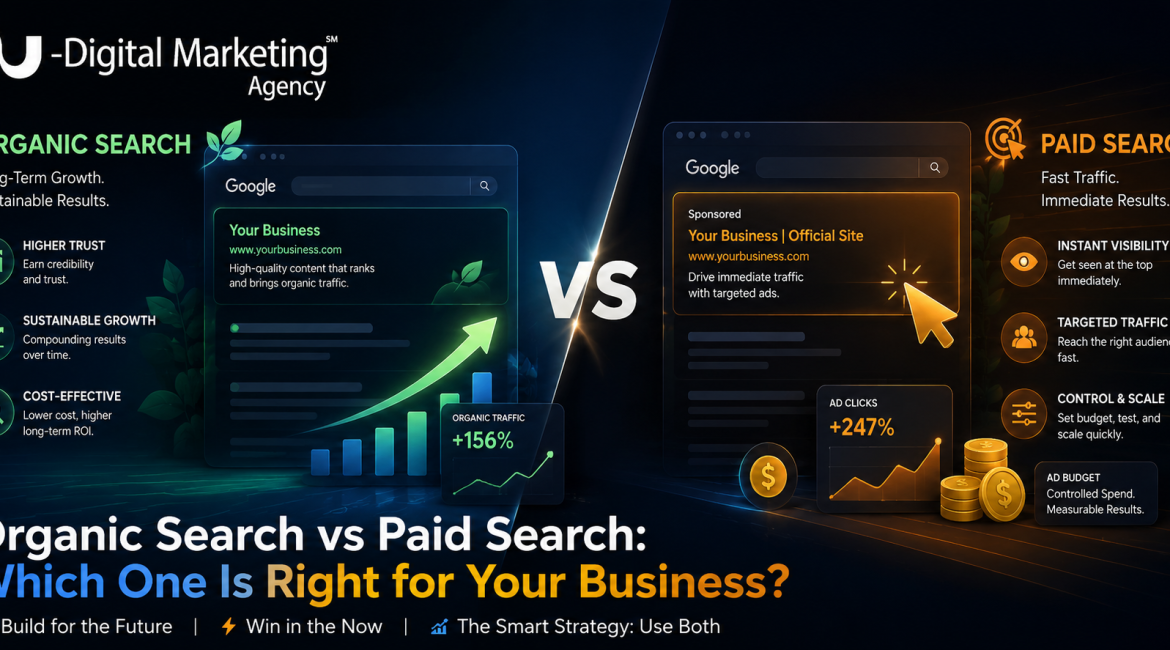
You know you need to be on Google. Customers are searching for what you sell. But you’re not sure how to get in front of them.
Someone told you about SEO. Someone else swears by Google Ads. Both cost money. Both take time. But they work completely differently.
Let me break down the organic search vs paid search decision so you can spend your marketing budget wisely.
The Short Answer
Organic search is free traffic from Google’s regular search results. You earn it over time with good SEO. Paid search is Google Ads. You pay every time someone clicks on your ad.
Organic takes time but builds long-term value. Paid gives immediate results but stops the moment you stop paying.
Understanding the organic search vs paid search tradeoffs helps most businesses realize they need both. Just in different ways.
What Is Organic Search?
Organic search results are the regular listings on Google. No “Ad” label next to them. Just blue links to websites that Google thinks are most relevant to your search.
When someone searches “best coffee shop” and clicks on a regular link, that’s organic traffic. You didn’t pay for that click. Google sent it to you because your website earned that spot.
How organic search works: Google sends robots to crawl your website. Those robots read your content. Google decides if your site is relevant and trustworthy. If yes, Google shows your site for relevant searches. You don’t pay per click. You don’t pay per impression. You pay upfront with SEO work — content creation, technical fixes, link building.
Pros of organic search: Free clicks once you rank. Builds long-term asset. Trusted by users (no “ad” label). Compounds over time — rankings improve as you add more content. Higher click-through rates than ads.
Cons of organic search: Takes months to see results. Requires ongoing effort. No guarantees. Algorithm changes can hurt rankings. Competitive keywords are hard to win.
That’s one side of the organic search vs paid search comparison. Slow but steady. Expensive upfront, cheap long-term.
What Is Paid Search?
Paid search results are the ads at the top of Google. You’ve seen them. They say “Ad” in a little box next to the link. Businesses pay every time someone clicks.
When someone searches “best coffee shop” and clicks on an ad, the business pays Google for that click. Sometimes a dollar. Sometimes five dollars. Sometimes more, depending on the keyword.
How paid search works: You bid on keywords relevant to your business. You write ads. Google shows your ad when people search those keywords. You pay only when someone clicks (Pay-Per-Click or PPC). You control your daily budget. You can turn ads on and off instantly.
Pros of paid search: Immediate results. Turn it on today, get traffic today. Complete budget control. Target specific keywords, locations, times of day. Test different messages easily. Works well for competitive keywords.
Cons of paid search: Traffic stops when you stop paying. Can be expensive for competitive keywords. Some users ignore ads. Click fraud exists (bots clicking your ads). Requires ongoing management to be profitable.
That’s the other side of the organic search vs paid search comparison. Fast but temporary. Cheap upfront, expensive long-term.
The Cost Comparison Nobody Talks About
Let me give you real numbers so you understand the tradeoff.
Organic search costs: Upfront SEO work might cost $1,000 to $5,000 to get started. Monthly SEO maintenance might cost $500 to $2,000 per month. After 12 months, you might have invested $6,000 to $24,000. But then traffic keeps coming. Year two costs less because the foundation is built. Year three costs even less.
Paid search costs: Average cost-per-click varies by industry. Legal keywords might cost $50+ per click. Local plumber keywords might cost $5 to $15 per click. A small budget of $1,000 per month gets you 100 to 200 clicks. Turn off the budget, traffic stops immediately.
Over three years, organic search usually costs less per click. But it takes time to get there. Paid search costs more per click but works instantly.
That’s the financial reality of organic search vs paid search. Organic is a long-term investment. Paid is an operating expense.
Trust and Credibility Differences
This matters more than most business owners realize.
Studies consistently show that users trust organic results more than paid ads. Organic results feel earned. Ads feel bought. A #1 organic result says “Google thinks this is the best answer.” A paid ad says “this business paid to be here.”
That doesn’t mean ads are bad. They work. But the psychology is different.
For high-consideration purchases — choosing a doctor, hiring a lawyer, picking a contractor — organic trust matters a lot. For low-consideration purchases — buy shoes, order pizza, find a plumber — ads work fine.
Understanding trust signals helps you decide in the organic search vs paid search debate. Do you need credibility or just visibility?
Which One Should You Prioritize?
Let me give you a simple framework.
Prioritize paid search if: You need customers this week. You’re launching a new product or service. You’re testing a new market. Your industry is very competitive. You have budget but no time. You can afford to spend $1,000+ per month on ads. You want precise targeting and immediate feedback.
Prioritize organic search if: You have more time than money. You’re building a long-term business. Your customers do research before buying. You want sustainable, compounding traffic. You have content you can optimize. You’re willing to wait 6 to 12 months for results. You want higher trust and credibility.
Do both if: You have the budget and patience. Use paid search to get immediate traffic while organic builds. Use organic search to reduce your dependence on paid over time. This is what smart businesses do.
That’s the strategic answer to organic search vs paid search. It’s not either-or. It’s when and how much.
A Realistic Hybrid Approach
Here’s what I recommend for most small businesses.
Months 1 to 3: Start with paid search. Get immediate traffic while you build your organic foundation. Set a modest budget — $500 to $1,500 per month. Learn what keywords convert. Use that data to guide your SEO.
Months 3 to 9: Ramp up organic efforts. Create content. Optimize your site. Build local citations. Get reviews. Watch organic traffic slowly grow. Gradually reduce paid spend as organic improves.
Months 9 to 12: Reassess. Is organic delivering enough leads? If yes, shift more budget from paid to organic. If no, keep both running.
Beyond 12 months: Organic should be your primary traffic source. Paid should fill gaps — seasonal peaks, new service launches, competitive threats.
This hybrid approach gives you the best of both sides of the organic search vs paid search equation. Immediate results plus long-term sustainability.
The Bottom Line
Organic search and paid search are not enemies. They’re tools. Each has strengths and weaknesses. Organic takes time but builds lasting value. Paid works immediately but costs money forever.
The organic search vs paid search decision isn’t about choosing one. It’s about using each for what it does best. Paid for immediate visibility and testing. Organic for sustainable, trusted, compounding traffic.
Start with paid if you need customers now. Start with organic if you’re playing the long game. Do both when you can. That’s how you win at search.
