
You’re spending money on marketing. Maybe SEO. Maybe Google Ads. Maybe social media. Maybe all of the above. But do you know if it’s actually working?
Not “do you feel like it’s working?” Do you know with actual numbers?
That’s where ROI comes in. Let me explain what is ROI in marketing and how to calculate it in plain English.
The Short Answer
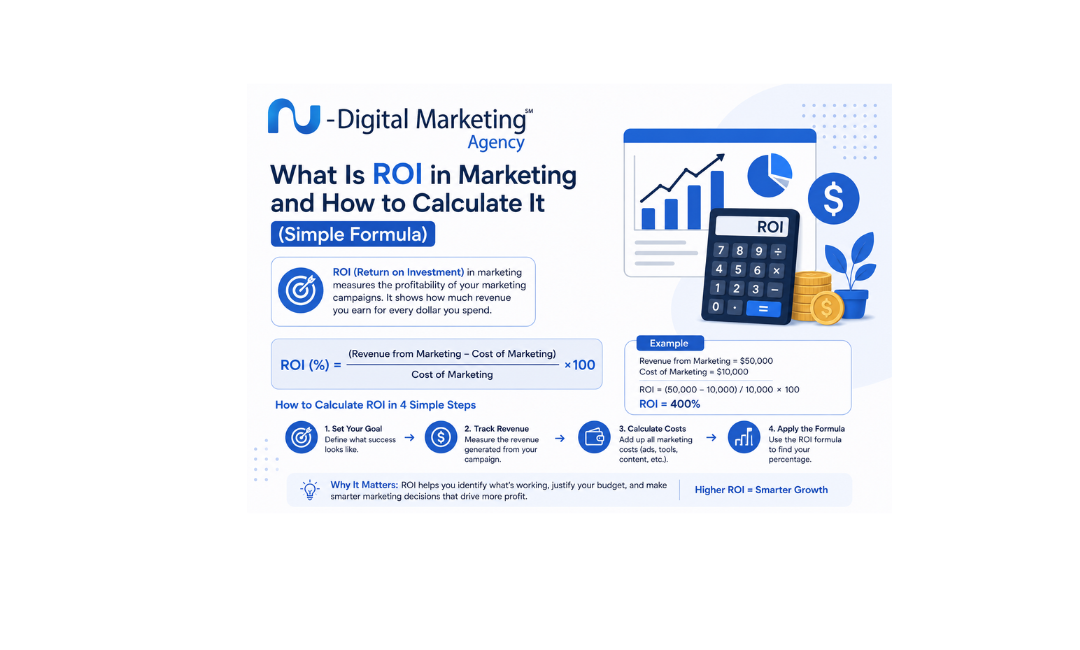
ROI stands for Return on Investment. It’s a simple formula that tells you how much money you’re making back for every dollar you spend on marketing.
The formula is: (Revenue from marketing – Cost of marketing) ÷ Cost of marketing = ROI as a percentage.
If you spend $1,000 and make $2,000, your ROI is 100%. You doubled your money. If you spend $1,000 and make $500, your ROI is -50%. You lost money.
Understanding what is ROI in marketing and how to calculate it helps you know which marketing channels are worth your money and which are wasting it.
The Simple ROI Formula (With Examples)
Let me give you the formula first, then walk through real examples.
ROI Formula: (Gain from investment – Cost of investment) ÷ Cost of investment × 100 = ROI percentage
Example 1: You spend $500 on Google Ads. From those ads, you get $1,500 in sales. ($1,500 – $500) ÷ $500 × 100 = 200% ROI. You made $3 for every $1 spent. That’s excellent.
Example 2: You spend $2,000 on SEO services. From organic traffic, you get $2,000 in sales. ($2,000 – $2,000) ÷ $2,000 × 100 = 0% ROI. You broke even. No profit, but no loss.
Example 3: You spend $1,000 on social media ads. You get $600 in sales. ($600 – $1,000) ÷ $1,000 × 100 = -40% ROI. You lost money. Time to change your strategy or stop spending.
That’s the basic math behind what is ROI in marketing and how to calculate it. Simple subtraction and division.
Why Marketing ROI Is Harder Than It Looks
The formula is simple. But getting the numbers right is tricky. Here’s why.
Problem #1: Attribution. A customer sees your Facebook ad. Then searches for your business on Google. Then clicks an organic result. Then calls you a week later. Which marketing channel gets credit for the sale? Facebook? Organic search? Both? This is called attribution. And there’s no perfect answer.
Problem #2: Delayed results. SEO takes months to show results. A blog post you write today might generate leads next year. How do you calculate ROI for something that pays off over 12 months? You need to track over longer time periods.
Problem #3: Indirect value. Not every marketing activity leads directly to a sale. Brand awareness campaigns don’t generate immediate revenue. But they make future campaigns work better. How do you calculate ROI for awareness? You can’t easily. But that doesn’t mean you should stop doing it.
Problem #4: Tracking failures. If you don’t have proper tracking setup on your website, you won’t know which marketing channels are driving sales. Phone calls are especially hard to track. Without tracking, you can’t calculate ROI at all.
These problems don’t mean you should ignore ROI. They mean you need to be smart about what is ROI in marketing and how to calculate it given real-world complexity.
How to Calculate ROI for Different Marketing Channels
Let me give you practical approaches for each channel.
Google Ads ROI: This is the easiest. Set up conversion tracking. Track form fills and phone calls. Assign a dollar value to each conversion (average sale amount). Google will calculate ROI for you automatically. Check your “Conversion value per cost” column.
SEO ROI: This is harder because SEO is ongoing. Track organic traffic in Google Analytics. Estimate your average conversion rate. Estimate your average sale value. Calculate: (Organic traffic × conversion rate × average sale value) ÷ SEO cost. Track over 6 to 12 month periods, not month to month.
Social Media ROI: Run Facebook or LinkedIn ads with conversion tracking. Similar to Google Ads. For organic social media, ROI is harder to measure. Track engagement, website clicks, and branded searches. Understand that organic social builds awareness, not direct sales.
Email Marketing ROI: This is famously high. Track opens, clicks, and purchases from each email campaign. Formula is the same. Many businesses see 3,000% to 4,000% ROI from email because it’s so cheap.
Print and Traditional Marketing: Use unique phone numbers, QR codes, or landing pages. Track responses. Calculate ROI the same way.
Each channel requires different tracking methods. But the underlying math for what is ROI in marketing and how to calculate it stays the same.
What Is a Good Marketing ROI?
This depends on your industry and profit margins. But here are general benchmarks.
Average ROI across all marketing channels: 5:1 or 500% is considered strong. You make $5 for every $1 spent. Many businesses aim for 4:1 to 6:1.
Excellent ROI: 10:1 or 1,000% is exceptional. You make $10 for every $1 spent. This happens with email marketing and well-optimized Google Ads.
Minimum acceptable ROI: 2:1 or 200% is often the break-even point once you account for product costs and overhead. Below 2:1, you’re likely losing money after expenses.
Negative ROI: Below 0% means you’re spending more than you’re making. Stop or fix immediately.
Remember: These are revenue numbers, not profit. If you have 50% profit margins, a 2:1 revenue ROI equals breakeven profit. You need to adjust for your specific business.
Knowing these benchmarks helps you evaluate what is ROI in marketing and how to calculate it for your own campaigns.
How to Improve Your Marketing ROI
Once you know your ROI, here’s how to make it better.
Cut what’s not working. If a channel has negative ROI, pause it. Move that budget to channels with positive ROI. Don’t keep spending money on losing campaigns just because you always have.
Optimize what’s working. A channel with 200% ROI could become 400% with better targeting, better ads, or better landing pages. Test continuously. Small improvements add up.
Increase customer lifetime value. Getting a customer to buy once is good. Getting them to buy repeatedly is better. Email marketing, loyalty programs, and excellent service increase lifetime value. Higher lifetime value means higher ROI from acquisition marketing.
Reduce costs. Can you get the same results for less money? Negotiate with vendors. Improve your own skills. Automate manual tasks. Lower costs increase ROI directly.
Improve conversion rates. Getting more sales from the same traffic is pure profit. Test your website. Test your calls-to-action. Test your checkout process. Better conversion rates dramatically improve ROI.
These strategies work because they directly affect the numbers in your ROI formula. That’s the practical application of what is ROI in marketing and how to calculate it.
Common ROI Mistakes to Avoid
Let me save you from these errors.
Mistake #1: Not tracking at all. You’re guessing. Stop guessing. Set up tracking. Get real numbers.
Mistake #2: Using revenue instead of profit. Revenue ROI looks better than profit ROI. But profit is what actually matters. Calculate both. Know the difference.
Mistake #3: Ignoring attribution. Giving all credit to the last click ignores all the marketing that led to that click. Use multi-touch attribution if possible.
Mistake #4: Looking at too short a timeframe. SEO and brand campaigns take time. Judge them over 6 to 12 months, not month to month.
Mistake #5: Forgetting overhead. Your time counts as a cost. Agency management fees count. Software subscriptions count. Include all costs, not just ad spend.
Avoid these and your ROI calculations will be much more accurate. That’s the final piece of understanding what is ROI in marketing and how to calculate it correctly.
The Bottom Line
Marketing ROI tells you if your money is working or wasting. The formula is simple: (Revenue – Cost) ÷ Cost = ROI percentage. But getting accurate numbers requires proper tracking, attribution, and timeframes.
Start tracking today. Set up Google Analytics conversion tracking. Assign values to leads. Calculate ROI for each channel monthly. Cut what’s losing money. Optimize what’s winning.
Now you know what is ROI in marketing and how to calculate it. Stop guessing. Start knowing. Your marketing budget will thank you.
